Saturday, June 9, 2012

Pill Millipede -Sphaerotheriida

I have come across these a couple of times and only now discovered what they are ..... a Pill Millipede (Sphaerotheriida). They curl up into a ball like this at the slightest hint of danger so naturally one cannot see that they have two pairs of legs per segment which would identify them as millipedes. Next time I find one I will take the time to be more careful and wait until it unrolls itself so I can get a better picture. :) It is probably about 3cm (1 1/2") in length.

Thursday, June 7, 2012

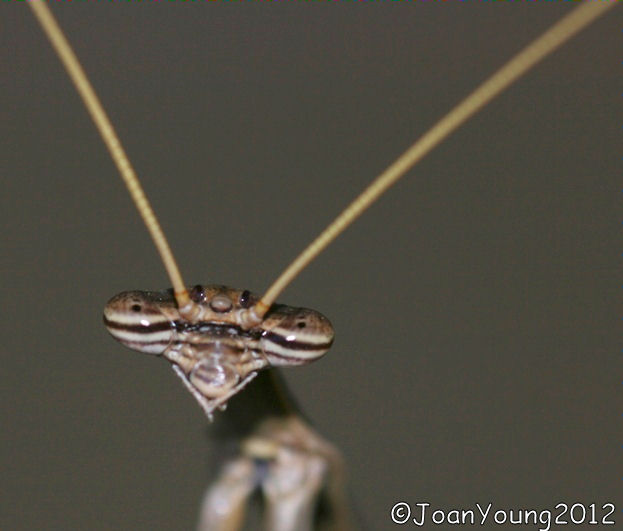
Giant Mantis (Hoplocryphella grandis)

Family: Thespidae
 
 What a performance it was to try to capture the open wings of this unusual creature!!
 It would only do that if I touched it and by the time I had done so, picked up the camera again and focused, it had closed its wings!! LOL!! Anyway, I managed to get a couple of pictures to show you. J
They are large and sources say they grow up to 6cm in length but this one was closer to 10cm (4") and is the largest mantis I have ever seen.

They are attracted to lights at night and I found this one clinging to my door after I had switched on an outside light to see what it would attract.


Because they are so thin and their color blends in so well with the trees and shrubs, they are extremely hard to spot in this habitat.

Tuesday, June 5, 2012

Woodlice

Family Porcellionidae
Woodlice are limited to moist environments such as well watered gardens and forest litter. They belong to the same family as crabs and crayfish, namely Crustacea.

They have about ten segments or more to their bodies and each of the first seven have a pair of legs.
 Their diet consists of fungi and decaying plant material. They multiply rapidly and are nocturnal therefore can become pests in places such as cellars.


There are about 200 species in South Africa.

Sunday, June 3, 2012

Fruit Chafer (Anisorrhina sternalis)

Family Scarabaeidae
Like all Fruit Chafers, these feed on flowers and fruit.
 It is a large beetle, about  5cm (1”) in length.

Fruit chafer larvae feed up to 3 years underground before development.


Friday, June 1, 2012

Nyala (Tragelaphus angasii)

The male has a distinctive white chevron between his eyes, and up to seven white verticle stripes on each side of his body, while the female has about nine.


These stripes are very noticeable on the younger animals, but they grow lighter or disappear as they grow older.
 Very often nyala are confused with kudu and bush buck, although the kudu is much larger when fully grown and the bushbuck only slightly bigger than the nyala.


They make a barking-like sound when alarmed.
 When they give birth, the female will hide her young for anything up to three weeks in order to allow it to grow strong so that it can better protect itself from predators.


Like most other antelope species, only the males have horns. They are lyre- shaped and the longest horns that have been recorded were 83,5 centimetres.
Their gestation period is about seven months after which a single calf is born.


They are usually found in small herds of two to four, but in certain areas, due to food supplies and water, larger herds can be observed.


Their favourite habitat is riverine areas with a lot of thickets for them to hide in.


They will drink freely when water is available, but are not dependant upon it.


Nyala are very shy creatures and are seldom seen close up.


In a family group, a female will be their leader as the males mostly form herds on their own until the rutting season.
Info: Unique Facts about Wildlife in South Africa (Joan Young)

Wednesday, May 30, 2012

Acari - Ticks

Reading “The origins of the group are late in evolutional terms – about 120 million years ago.” I wonder what ever happened to start them developing in the first place? Humans and animals alike will agree that ticks are something we could have done without!! LOL!!


“While the larvae or nymphs of hard ticks wait for a host to happen by they enter into a kind of dormant condition. Their metabolism comes to a vertual standstill and they can persevere in this condition for months on end. They will, however, avoid climate extremes by crawling down and seeking shelter every night. The one stimulus that will invariably wake them up within seconds is the vibration and smell of an approaching host.” (that’s US again!! LOL!!)

Bont-legged Tick (Hyalomma)
 “Ticks are largely dependent on the Haller’s organ on their front legs to identify and find their hosts by smell. The ‘hunters’ can even determine the direction of the largest CO² concentration by stretching their two front legs wide”


“Cattle and game famers generally believe that veld fires are an effective way to control ticks. Apparently this is a questionablebelief. The larvae and nymphs perch on vegetaation and grass waiting for hosts are very senseive to the smell of smoke and drop off to seek shelter under litter or stones long before the fire reaches them.”


“In summer nobody in Africa in his (her) right mind will go on a hike through grassland wearing short pants. (How true!!) Long pants tucked into socks, boots or puttees and a shirt tucked into the belt will keep most ticks off your body, since they always crawl upwards. Insect repellents on clothing also repell ticks.”


So in other words, there is NO getting away from these nasties!!
Brown Tick (Rhipicephalus)

Extracts from : Goggo Guide (Erik Holm and Ansie Dippenaar-Schoeman)

Monday, May 28, 2012

Common Dotted Fruit Chafer (Cyrtothyrea marginalis) Scarabaeidae

 Family Scarabaeidae 
These are small beetles, about 9mm and are found in the coastal areas as well as central and northern regions.

The adults are attracted to fruits and flowers especially Arum Lilies.

Saturday, May 26, 2012

Grasshoppers - Orthoptera


As you have probably noticed, I have not been posting many grasshoppers lately and that is not because I do not have pictures but because there is so little information available on them.
Acrididae Sp
 On a visit to an entomologist, I asked the reason for this and was told that there is no one study them!! Can you believe it? 
Acrididae Sp
I would think that the kind of destruction they cause sometimes plus the wonderful variety to be found that they would be an interesting species to study, but it seems not.
Acrididae Sp
 
Green Milkweed Locust

Green Milkweed Locust

Green Milkweed Locust


Thursday, May 24, 2012

Sulphur Orange Tip (Colotis auxo) Male

Family Pieridae
They are seen throughout the year peaking in late summer and autumn.

Their habitat varies from hillsides and forest margins to the coast and flatlands.

They are found along the eastern coast and into the northern areas.

Tuesday, May 22, 2012

Natal Sprite (Pseudagrion spernatum) Female

Family Coenagrionidae
These are widespread and are found from Port Elizabeth up along the coast an further inland heading north and were first described in SA in 1911.

The male’s uniformly blue body and the specific blue shapes on the tails of both sexes is quite distinctive.

They frequent vegetated margins of streams and rivers.