Wednesday, April 22, 2009

Who will win?

I witnessed a fight between a young cockroach / pillbug (?) and an ant and who do you think won?

One of the ants had him by the leg and would not let go.
Soon a second ant joined in and they started to bite off pieces of its leg. As you can see top, just off centre, it's foot is missing.
Another ant got hold of the antennea and bit a piece of it off while another kept its hold on the leg.
As you can see, the insect is only about 1/10th of the size.
Finally, after about 15 minutes the insect was exhausted and gave up the fight. The rest of the ants came around and draged it off to their nest, by this time, more limbs were missing.

Tuesday, April 21, 2009

Tortoise - Testudines

 
Although the word turtle is widely used to describe all members of the order Testudines, it is also common to see certain members described as terrapins, tortoises or sea turtles as well. Precisely how these alternative names are used, if at all, depends on the type of English being used.

British English normally describes these reptiles as turtles if they live in the sea; terrapins if they live in fresh or brackish water; or tortoises if they live on land. However, there are exceptions to this where American or Australian common names are in wide use, as with the Fly River turtle.

American English tends to use the word turtle for all freshwater species, as well as for certain land-dwelling species (e.g. box turtles). Oceanic species are usually referred to as sea turtles, and tortoise is restricted to members of the true tortoise family, Testudinidae. The name terrapin is typically reserved only for the brackish water diamondback terrapin, Malaclemys terrapin; the word terrapin being derived from the Algonquian word for this animal.
Female tortoises dig nesting burrows in which they lay from one to thirty eggs. Egg laying typically occurs at night, after which the mother tortoise covers her clutch with sand, soil, and organic material. The eggs are left unattended, and depending on the species, take from 60 to 120 days to incubate. Hatchlings are born with an embryonic egg sac which serves as a source of nutrition for the first 3 to 7 days until they have the strength and mobility to find food.
There are many old wives tales about the age of turtles and tortoises, one of which being that the age of a tortoise can be deduced by counting the number of concentric rings on its carapace, much like the cross-section of a tree. This is not true, since the growth of a tortoise depends highly on the access of food and water. A tortoise that has access to plenty of forage (or is regularly fed by its owner) will grow faster than a Desert Tortoise that goes days without eating.
Tortoises generally have lifespans comparable with those of human beings, and some individuals are known to have lived longer than 150 years. Because of this, they symbolize longevity in some cultures, such as China. The oldest tortoise ever recorded, almost the oldest individual animal ever recorded, was Tu'i Malila, which was presented to the Tongan royal family by the British explorer Captain Cook shortly after its birth in 1777. Tui Malila remained in the care of the Tongan royal family until its death by natural causes on May 19, 1965. This means that upon its death, Tui Malila was 188 years old. The record for the longest-lived vertebrate is exceeded only by one other, a koi named Hanako whose death on July 17, 1977 ended a 215 year life span.

The Alipore Zoo in India was the home to Adwaita, which zoo officials claimed was the oldest living animal until its death on March 23, 2006. Adwaita (sometimes spelled with two d's) was an Aldabra Giant Tortoise brought to India by Lord Wellesley who handed it over to the Alipur Zoological Gardens in 1875 when the zoo was set up. Zoo officials state they have documentation showing that Adwaita was at least 130 years old, but claim that he was over 250 years old (although this has not been scientifically verified). Adwaita was said to be the pet of Robert Clive.

Info: https://simple.wikipedia.org/wiki/Turtle

Sunday, April 19, 2009

Montecasino - Bird Show - Part 4

So many of these owl shots came out nice that I could not decide which to post and so ended up with all of them...

The Cape Eagle Owl can be seen in many parts of southern Africa, but nowhere is it common. It lives in rocky, sometimes mountainous areas, in various vegetation types. Most of its diet consists of mammals, but it also feeds on birds and invertebrates. Amazingly, it can carry prey that is 4,5 kg, or 4 times its weight! It lays 1-3 eggs, and incubation lasts for 34-38 days, the female doing most of it, with the male sometimes taking over while the female feeds. After fledging, juveniles stay dependent on their parents for 2-3 months, before leaving completely.
It has an extremely fragmented range, and they are no places where you can see it easily. It prefers mountainous areas with cliffs, outcrops and gorges, and can live as high as 2500m above sea level.
Its diet consists mostly of mammals, although it varies between regions. It also eats a number of birds species, as well as invertebrates. It hunts at night, searching for prey on low perches.
It uses scrapes in the ground as nests, often on ledges, hidden by trees or rocks, in cliff recesses, regularly near streams or rivers. Females often lie in the scrape for days before laying their eggs.
It sometimes uses the same nest site repeatedly, but not every year.

Friday, April 17, 2009

Two-pip Policeman (Coeliades pisistratus) Hesperiidae

This differs from the Garden Policeman by the black dots on the wing. In the warmer areas, they breed throughout the year.

Thursday, April 16, 2009

Miscellaneous Spiders

We have a very wide variety of spiders here but there are not many which I know the names of. Most of these are small to medium in size.


Wednesday, April 15, 2009

Long Skimmer male (Orthetrum trinacria) Libellulidae

It blends in so well on this pathway.
Their eggs are scattered just under the surface of the water.

Tuesday, April 14, 2009

White-banded Clear-wing moth (Chamanthedon) Sesiidae

This is a quote from my Field Guide to Insects of South Africa which I use for almost everything, except in this case where I have to ask Ted's help. He is a star!! :)

"Clear-wing moths - Family Sesiidae : Easily distinguished as their wings lack scales and are transparent with a black, brown yellow or orange border.
Body often banded and legs may be heavily cloaked in hairs. Fan of long hairs at the end of the often-slender abdomen.
Excellent mimics of wasps and bees, day-flying but rarely encounted as they are never common and have a very rapid flight.
Larvae are borers of trees and shrubs and, in temperote regions, may attain pest proportions in orchards.


Probably far more than the 90 known species in the region."


This book is the only one on insects available and the authors are Mike Picker, Charles Griffiths and Alan Weaving. My thanks to them on an excellent publication.


Monday, April 13, 2009

Mystery Monday - Part 13

Todays mystery is going to be completely different. As you can see, I am showing you the whole insect and asking you to guess what it is.

Here are 2 things to bear in mind:

1. If you think you know what it is, think again because it isn't.

2. I did not know myself what it was and had to ask my good friend Ted from Beetles In The Bush for his help in identifying it. LOL!!

3. Does it sting or bite? The answer will found in tomorrows post. :)

Sorry Ted, you are excluded from guessing on this one, I have sent you enough kisses to last you a while anyway. LOL!! Thank you very much for your help on this one. :) You kindness is much appreciated.

Sunday, April 12, 2009

Montecasino - Bird Show - Part 3

The Gymnogene (now renamed African Harrier-hawk) is found in most areas of SA. They are fairl large in size and easily distinguished by their pink beak and yellow legs. They are usually solitary and hunt by raiding nests of other birds such as weavers and swallows. In courtship flight, the male rolls over and touches the talons of the female.
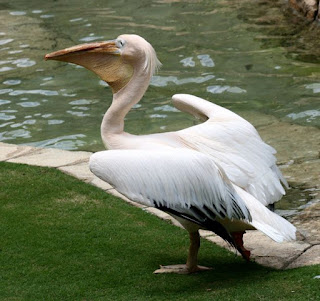
Great White Pelicans breed in Africa, and in Europe and Asia from Greece to Vietman. The world's population is thought to total about 90 000 pairs, of which about 80% are in Africa.
Their diet consists of fish and some crustaceans. I love the way I managed to catch this one skimming along prior to landing in the water.
Great White Pelicans are gregarious birds and large flocks often fish together encircling and trapping shoals of fish in shallow water where all the birds are easily able to scoop up fish in the skin pouch below the bill. They are excellent swimmers and also good fliers.
White Pelicans usually nest in colonies situated on an island, or remote parts of a large pan. The nest is a stick structure placed on the ground.
A single, strange colored Peacock was sitting above the building watching the show too.
The Spotted Dikkop has large eyes as he is a nocturnal bird and is very vocal, especially after rain. They eat grass seed, insects, crustaceans and frogs.
Crested Guineafowl prefer matted thickets at the edge of grasslands. They are found in flocks of up to 30 birds and will follow troops of monkeys to feed on fallen fruit.