They are found throughout Africa. This one is still immature and differs in colour slightly from the adult.
Showing posts with label identification. Show all posts
Wednesday, October 30, 2013
Julia Skimmer (Orthetrum julia falsum) Libellulidae Imm
This beautiful dragonfly was flying around outside my office.
They are found throughout Africa. This one is still immature and differs in colour slightly from the adult.
They are found throughout Africa. This one is still immature and differs in colour slightly from the adult.Friday, September 27, 2013
Southern Foam Nest Frog (Chiromantis xerampelina)
Family Rhacophoridae
This is an extract from Frogs and Frogging in South Africa (Vincent Carruthers and Louis do Preez)“During the rainy season one frequently finds balls of white foam suspended on branches over the water. These are the ingenious nests of the Southern Foam Nest Frog. Before laying her eggs the mating female secretes a fluid that is churned into a stiff froth by continuous movement of the hind legs of the mating pair.
They are joined by several other males who jostle for positions close to the female. After about 15 minutes the female releases the first batch of eggs and they are fertilized by her mating partner. As the eggs are laid, all of the frogs churn them into the foam. The process lasts all night with the female periodically leaving the nest to re-hydrate herself in the water below and frequently changing partners on her return.
The following night she sometimes returns alone to add more foam to the outside of the nest. In sunlight the outer surface of the nest hardens into a crust. The foam protects the eggs from aquatic predators and functions as an isolator, allowing the eggs to develop at an even temperature.”
Info: Frogs and Frogging in South Africa (Vincent Carruthers & Louis du Preez)
Monday, August 19, 2013
Greater Leaf-rolling Frog (Afrixalus fornasinii)
Family Hyperoliidae
These are found along the extreme north eastern coast of SA.
Their habitat is savanna pans.
These are found along the extreme north eastern coast of SA.
Their habitat is savanna pans.
Thursday, May 16, 2013
Peaceful Giant Ground Beetle (Tefflus)
Family Carabidae
Extremely large beetle of nearly 5cm in body length.
They are found during the day hunting for insects.Found in the northern and north eastern regions.
Info: Field Guide to Insects of South Africa
Sunday, April 14, 2013
Trident Dung Beetle (Heliocopis neptunus)
Family Scarabaeidae
Large bodied, about 37mm.
Males have a fork-like 3-pronged extension to proton and a backward-curved horn on its head.Adults burrow below or beside fresh dung.
They are active at night and attracted to lights.
Males and females jointly pack dung for breeding in hemispherical layers in expanded sections of tunnel forming spherical brood masses that resemble brood balls, each with an egg.
Found in most areas except the Freestate and Cape.
Info: Field Guide to Insects of South Africa
Thursday, March 21, 2013
Darting Cruiser Dragonfly (Phyllomacromia picta)
Family Aeshnidae
They are large and one of our really pretty ones with those green eyes.It came and landed right in front of me so I was able to get some great shots of it.
Monday, February 25, 2013
Longhorn Beetle (Evgenlus plumatus)
Family Cerambycidae
A medium size and very colourful beetle.
No information is available on it either but I post these pictures for identification purposes.
Friday, February 1, 2013
Jewel Beetle (Damarsila)
Family Buprestidae
A large beetle about 2.5cm in length.All jewel beetles have the same body shape and come in a variety of colours, some metallic.
Adults feed on nectar, pollen and foliage.
Adults are short-lived but immatures can take up to 35 years to complete their development, longer than any other insect.
Labels:
Buprestidae,
Damarsila,
identification,
Jewel Beetle
Monday, January 28, 2013
Swollen-legged Leaf Beetle (Sagra bicolor)
Family Chrysomelidae
They are fairly large, nearly 2cm in length with the male having the swollen legs which are much longer than his body.
They are found only in the northern areas.
Monday, January 14, 2013
Turquoise Longhorn (Prosopocera lactator)
Family Cerambycidae
This is another beetle I have been looking for and was pleased to eventually find it.
They lay their eggs in the stems of the Buffalo Thorn.It is about 2.5cm in length and is a light peppermint green and brown in colour with turquoise leg markings.
Sunday, December 16, 2012
Painted Reed Frog (Hyperolius marmoratus)
Unmistakable colouring and markings makes this frog easy to recognise.
They are found in savanna pans where they call from the nearby reeds.
They have a short, loud, bell-like, piercing whistle.
Info: Frogs and Frogging in South Africa (Vincent Carruthers & Louis du Plessis)
Saturday, November 24, 2012
Spotted Tortoise Beetle (Conchyloctenia punctata)
Family Chrysomelidae
They are common in South Africa and can vary from a copper colour to orange or red.
They are smallish, about 12mm in length.
The front portion is a reddish brown unlike most other tortoise beetle which have an almost clear ridge around it.
The eggs are laid on the underside of the leaf and hatch after about two weeks, the pupa being white with black markings.
Beetle larvae stack their excreta (the long thin, black filaments) as well as cast off skins onto a thin, fork-like appendage near the muscular anus. This forms the “tail” of the larva.
Wednesday, October 31, 2012
African Common White (Belenois cerona severina)
Males have a wingspan of 40-45mm. They are found mainly along the east coast and northern regions.
| Male top of wing |
Wednesday, September 5, 2012
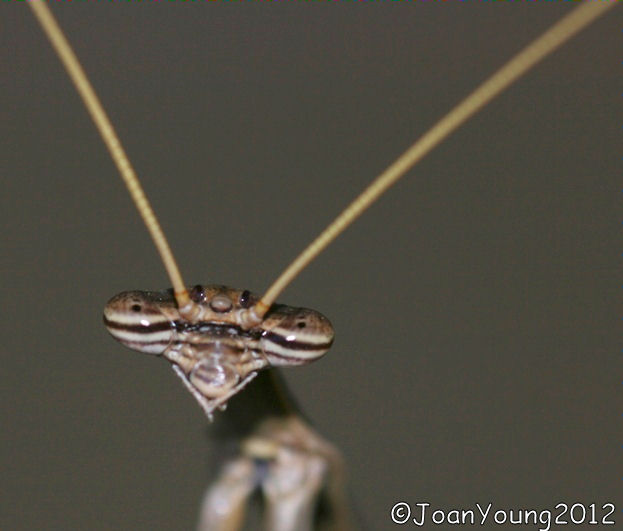
Sibyllid Mantis (Sibylla pretiosa)
Family Sibyllidae - This is the only one of this family known in SA
It is of medium size - body length about 4.5cm
It is usually found on the trunk of trees where it moves around feeding off insects.Thank you Barry for the confirmation of the species.
Labels:
identification,
Sibylla Pretiosa,
Sibyllid Mantis,
Sibyllidae
Thursday, June 7, 2012
Giant Mantis (Hoplocryphella grandis)
Family: Thespidae
It would only do that if I touched it and by the time I had done so, picked up the camera again and focused, it had closed its wings!! LOL!! Anyway, I managed to get a couple of pictures to show you. J
They are large and sources say they grow up to 6cm in length but this one was closer to 10cm (4") and is the largest mantis I have ever seen.
They are attracted to lights at night and I found this one clinging to my door after I had switched on an outside light to see what it would attract.
Because they are so thin and their color blends in so well with the trees and shrubs, they are extremely hard to spot in this habitat.
Labels:
Giant Mantis,
Hoplocoryphella grandis,
identification,
Mantis,
thespidae
Subscribe to:
Posts (Atom)