
A Cymbidium orchid is a great starter orchid to try your green thumb if you live in coastal California, New Zealand, Australia, South Africa or the Mediterranean. Originally from a higher altitude in Central and Southeast Asia, and all the way to Australia, the standard Cymbidium enjoys a cool climate and strong light with partial shaded conditions. But the smaller-flowered terrestrial and tropical species live in different environments, so even if you do not have perfect Southern California weather, you can still grow these beauties. Let me tell you a little bit more about the different types of Cymbidium.
 Cymbidium has retained its status as a celebrity orchid for thousands of years since the time of ancient China. Why do people love them so much? Cymbidium orchid hybrids produce up to 30 flamboyant and sometimes fragrant blooms on a single spike, and the flowers last couple of months. The Cymbidium I received for my birthday (boyfriend, here’s your acknowledgment!) in January still looked pristine in April. But wait, there’s more! Even if you cut those spikes and put them in a vase, the flowers will last just as long. No wonder Cymbidium is one of the most popular orchids for corsages. And even though there are only 44 species, thousands of hybrids have been developed to satisfy people’s demand for variety.
 Standard Cymbidium Orchid
“Standard” Cymbidium refers to the large-flowered species from the Himalayas and China. These well-loved plants produce large, attractive flowers that come develop plants that produce the fullest looking flowers. Even though they are tolerant of extreme temperatures, to thrive and to produce flowers, they require frost-free cool nights (below 53°F/12°C) and warms days.
 Cymbidium demands a little more fertilizer than most other orchids, so be sure to apply fertilizer twice a month at half the strength that is prescribed on the instruction label. You can also use the slow-release fertilizer once a year and forget about it for the rest of the year.American Orchid Society provides a good one-page free culture sheet on standard Cymbidium, so you can print one out as a reference.
 Lady Slipper Orchids
Paphiopedilum orchids are the most commonly grown lady slipper orchids because they are more adaptable to cultivation than other kinds of ladyslippers. People who love Paphiopedilum are truly nuts about them, and some even believe it should be considered a separate family of its own. That’s quite understandable. The bizarre pouch- like lips are nothing like other flowers.
 The bottom sepals are merged to form a synsepal. The dorsal sepal is large and showy. In many slipper orchids, the two petals are quite flamboyant (imagine if Elton John were a flower); they can be so long as to reach 3 feet (1 meter) long in the case of Paphiopedilum sanderianum. It’s an awesome sight when the curly petals flow with the wind. Some Paphiopedilum even have warts and hair that are irresistible in a different way.
 The 60 Paphiopedilum species are native to India, southern China, New Guinea and the Philippines. The first Paphiopedilum hybrid was registered in 1869, and now the genus is by far the single most hybridized orchid. These 13,000 wonderful hybrids are available in myriad colors, sizes and shapes. They can easily be grown at home, and each flower can provide you weeks, if not months, of enjoyment in many different colors.
 Information supplied by Everything Orchids.

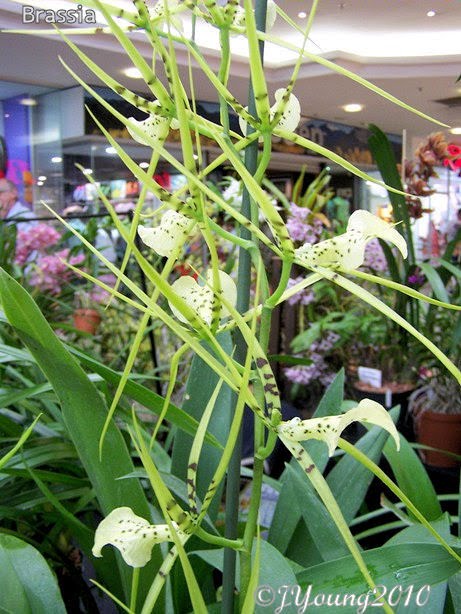


 They are tiny, maybe one inch in length but pretty nevertheless.


