Sunday, October 9, 2011

Turner’s Tubercled Gecko

(Chondrodactylus turneri)
They are widespread in the northern parts of South Africa and this one is about 6” excluding the tail.
They are nocturnal and feed mainly on grasshoppers, large moths and mantids.
They occur on rocky outcrops in or under which they hide during the day.
These are just the cutest feet!!
As you can see, at some time this one lost its tail and it is now growing out again.
Many species of reptiles, spiders, insects etc play dead and this is just what this one did. It stayed this way until I left the area.
Normally clutches of two hard shelled eggs are laid in rock cracks, under bark or in holes dug in the sand but several clutches can be laid by the female during the summer.

Friday, October 7, 2011

Acrididae - Common Stick Grasshopper

To date I have only seen pictures of these and found them in either plain green or plain brown.
 This one with pink stripes is quite unusual and as always, I wonder if it is a new species or just a species which is not very common?
 This is about 4" in body length so is not a baby which might still change color.

Wednesday, October 5, 2011

Large-fruited Bushwillow (Combretum Zeyheri)

The Large-fruited Bushwillow (Combretum Zeyheri) is a large tree growing to 10m in height.
This tree is said to indicate “sour bushveld” carrying poor grasses which are not usually palatable to stock and game.
The Afrikaans name Raasblaar is based on the sound made by the leaves and fruits in the wind and translated means “noisy leaf”.
Many animals feed off the leaves and fruit including giraffe, elephant and various buck species.
The roots are fibrous and woven into baskets and fishing traps. The crushed leaves combined with oil are used as an embrocation to ease backache and when mixed with water provide eye lotion.
The roots, together with other ingredients are regarded as a remedy for nose-bleedig and when pounded and mixed with fat, form an ointment to relieve haemorrhoids. The wood is yellow, termite and borer proof and it is a useful general purpose timber. It is easy to work but nor durable unless thoroughly seasoned.

Monday, October 3, 2011

Pretoria Zoo - 2

Images of the birds are difficult to get through the wire of the cages but this one of the Brown Snake Eagle did not come out too badly.
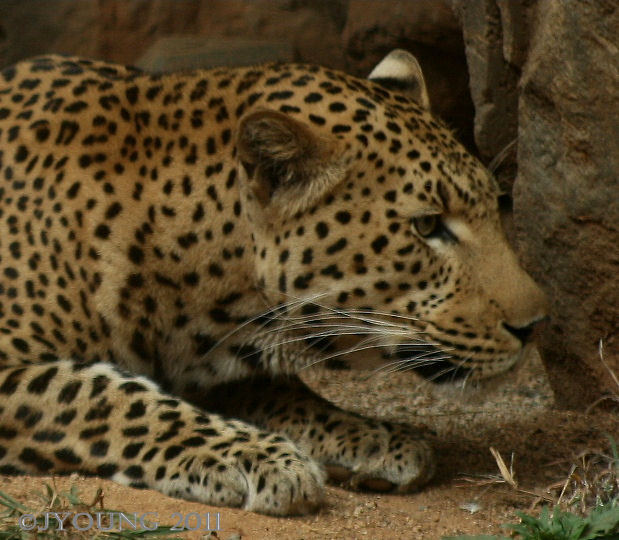
 It was feeding time and this leopard was listening to someone coming nearer in order to feed it.
 For more information on them, here is the link: http://saphotographs.blogspot.com/2009/05/leopard_26.html
 The poor Black Rhino looked so sad. There were always two of them in this cage and I wonder what happened to the other one? Do you know how to tell the difference between the two species: http://saphotographs.blogspot.com/2009/05/rhino.html
 Since my last visit, the Sable Antelope has had a young one. http://saphotographs.blogspot.com/2011/08/sable-antelope-hippotragus-niger.html

Saturday, October 1, 2011

Pretoria Zoo - 1

Blyth's Hornbill is found in Indonesia and its bill can be up to 10 inches in length.
 The gardens at the zoo are very pretty, even in winter.
 This made me smile. :) The hippo had such a self-satisfied look on his face, I wondered what he was dreaming about?
 The Secretary Bird (Sagittarius serpentarius) is endemic to Africa and stands about three feet in height. Prey consists of insects, small mammals, lizards, snakes and young birds and bird eggs. Sometimes it will eat dead animals killed in grass or bush fires.
 King Vutures come from South and Central America and have been know to live for up to 30 years in captivity.

Thursday, September 29, 2011

Solanum rantonnetii (Potato bush blue)

The Potato Bush is very common in our gardens. Other names: Potato bush blue, Paraguay nightshade, Blue lycianthes
 S. rantonnetii is a deciduous shrub forming purple-blue flowers throughout the summer, followed by red decorative fruit in autumn which is popular with the birds and is semi evergreen.
 Toxicity: All parts of plant are poisonous. If is ingested, may result in severe discomfort.
 They flower in summer and autumn.

Tuesday, September 27, 2011

Bongo (Antelope) - Tragelaphus eurycerus eurycerus

The Bongo sports a bright auburn or chestnut coat, with the neck, chest and legs generally darker than the rest of the body. Coats of male Bongos become darker and buffy as they age until they reach a dark mahogany-brown colour. Coats of female Bongos are usually more brightly coloured than those of males.


A white chevron appears between the eyes and two large white spots grace each cheek. There is another white chevron where the neck meets the chest. The large ears are to sharpen hearing, and the distinctive coloration may help Bongos identify one another in their dark forest habitats. Bongos have no special secretion glands and so rely less on scent to find one another than do other similar antelopes. The lips of a bongo are white, topped with a black muzzle.
 Like other forest ungulates, bongos are seldom seen in large groups. Males, called bulls, tend to be solitary while groups of females with young live in groups of 6 to 8. Bongos have seldom been seen in herds of more than 20. Gestation is approximately 285 days (9.5 months) with one young per birth with weaning at 6 months. Sexual maturity is reached at 24–27 months.


Like many forest ungulates bongos are herbivorous browsers and feed on tree/bush leaves, bushes, vines, bark and pith of rotting trees, grasses/herbs, roots, cereals, shrubs and fruits.
 Bongos require salt in their diet, and are known to regularly visit natural salt licks. Examination of bongo feces revealed that the charcoal from trees burnt by lightning is consumed. They have been known to eat burned wood after lightning storms. This behavior is believed to be a means of getting salts and minerals into their diet (See Animal Diversity link 2). This behavior has also been reported in the Okapi. Another similarity to the okapi, even though the bongo is unrelated, is that the bongo has a long prehensile tongue which it uses to grasp grasses and leaves.


Suitable habitats for bongos must have permanent water available. A large animal, the bongo requires an ample amount of food, and is restricted to areas with abundant year-round growth of herbs and low shrubs. Such restrictions have been said to account for the animal's limited distribution.

Sunday, September 25, 2011

Walk 7/31 - Part 4

The Brown Heart Beetle (Family Scarabaeidae - Subfamily Cetoniinae - Plaisir)
To date, I have only seen these brown ones but found some which are black too. I cannot find out if the difference in coloration is due to the age of the beetle or maybe a difference beween male and female.
 Caterpillars and more caterpillars. Even in winter there are some to be found but once again, no identification.
 Flowers are always a welcome find and make a nice find during the winter.
 We do have many different kinds which bloom the whole year round.
 I am keeping my eye on this egg sack but I know what is going to happen, it will wait for me to go past (or the day I don't check it) and then some lovely critter will pop out and guess what, I will have missed it again. :)
 There is a large tub of water where the animals come down to drink and I always stop by to see what is breeding in it. Needless to say, many insects drown in it too like this fly.  Now I know flies are not supposed to be pretty but you must admit it has a lovely pattern on it?

Friday, September 23, 2011

Gasteruptiidae - Wasps

The Gasteruptiidae family of wasps are small in body length and usually brown or black in color.
 They are easily identified by the abdomen arising from the top of the thorax and getting larger towards the tip. The females (as shown here) have a long ovipositor sometimes marked by a white tip.
 The hind portion (tibiae) of the leg is narrow at the base and swollen at the base. They are parasites of nests belonging to solitary wasps and bees.

Monday, September 19, 2011

Elephant Museum - Part 4 Shingwedzi

Shingwedzi (c.1934-1981)
Origin of Name: Shingwedzi was named after the river and rest camp where he spent the last few years of his life. (Shingwedzi means, “place of ironstone” referring to the gabbro rock outcrops common to the area. Shingwedzi is derived from the Tsonga word Ngwetse which means ‘the sound of metal objects rubbing against each other’).
 Range: Shingwedzi was known to move as far west as Nkokodzi and Chugamila hills and as far as the Lebombo’s in the vicinity of Shingwedzi Rest Camp.

Special Features: Shingwedzi’s ivory offers a good example of the classic master servant tusks. He had a large right servant tusk and a shorter left master tusk.
 General: Shingwedzi was found dead under a Sycamore Fig and short distance from Shingwedzi camp in January 1981, and as far as can be determine he died of natural causes. The age of an Elephant can be fairly accurately determined from the state of wear of the teeth. In the case of Shingwedzi the last molar (molar 6) was well worn down, giving him an estimated age of 65 (56) years.