Thursday, June 16, 2011

Autumn Walk - Part 6

As late as it is in the season, there are still wild flowers around and as always, some hungry bug to feed on it. :)
 Certain butterflies are found the year round no matter how cold it is. This one is from the Acrea family.
 Lots of plants are at the end of their season and are getting their seeds. They are kind of pretty.
 A Needle-nose fly still find nourishment.
 Some wild winter berries are not starting to get flowers. These should keep the birds going for the winter when everything else is scarce.
 This Crab Spider was not doing a very good job of being invisible was he? :) Sorry, some of these pictures are not right again. I wonder if blogger is ever going to fix the problem or put in something so we can turn it?

Tuesday, June 14, 2011

Macro versus close-up photography

The difference between macro and close-up photography has always been a very debated, and sometimes heated, subject. Some people will argue that it depends on the ratio of size depending on the object photographed but for me personally, it is a case of showing a small object in high definition, regardless of the object itself.


There is also a debate on the use of a mono or tripod but in my kind of photography these are useless as you have to be able to constantly move your camera more freely. For me, I found the use of a small bean bag on which to rest my camera a much better option and much less heavy than a tripod. Even a soft cloth of some kind which you can put on a rock or branch and place your camera on so it does not get scratched. Mono and tripods are very useful when it comes to stationary objects such as flowers etc.

Debateable is also the settings on the camera as many people tend to put the camera and lens on Auto. These depend very much on the type of camera one has and how well you are versed at doing your own setting. I prefer manual for both camera and lens as it gives me great flexibility. For example, the lens zooming in and out on auto trying to pick up your subject is very distracting, makes a noise and can take a long time and by then your subject has flown away.


Insect and nature photographs is surely one of the best subjects one can photograph for many reasons: It is challenging, subjects are plentiful even in winter and one does not need special cameras and lenses with which to do it. Some of my best macro shots have been taken with and ordinary Point and Shoot (Mik and druk) cameras. It is true what they say – it is not the camera which counts but the person behind it.

I have been doing close-up/macro photography for a while now, mostly insects and have discovered a world few have ever seen. Because of this, I have started a wider and wider circle of people now looking at insects in a whole new way. No more do they run for the can of Doom but instead go and grab their cameras. I think that once this bug has bitten you (excuse the pun) you begin to look at your garden and in fact anything in nature in a whole new way.

This type of photography teaches one a lot which is useful in other types of photography too such as patients. Stalking a butterfly or dragonfly in order to get close to it is something of an art and there are new techniques to learn in order to be successful. Probably the greatest tips I can give you are the following:

1. Learn to move very slowly.

2. Watch where the sun is and never allow your shadow to cross the subject.

3. In some cases such as dragonflies, first sit and watch them for a long while. You will see that they tend to land on the same piece of grass or stick every time. You can then go and sit nearby, get your camera ready and sit quietly waiting for them to return. Beware, the waiting period can be 20 minutes!! 

4. Some insects such as bees and butterflies prefer certain plant species. Walk in the veld and learn to identify these.

5. Practice holding your camera steady as in macro photography, the slightest movement will blur the picture. If you have nowhere to rest your camera, learn to tuck your elbow into your stomach and rest the camera on that. Also hold your breath for the instant you press the shutter.

I have started a research project and website on the biodiversity of our insect species as I receive many e-mails from people asking me what-is-this. There are so many species of reptiles, flowers, insects etc in South Africa which have not been discovered yet and though this has up to now been only a hobby with me, I am now looking for sponsors in order to do research on a full time basis. As it is, I have been commissioned by one of the government departs to collect specimens of certain beetles and record where they are found. With the ease of transportation nowdays, distribution maps are very out of date so if you are interested in having a new species named after you or your company, anyone sponsoring me will have first choice in this. My e-mail address is on my blog which can be found at http://saphotographs.blogspot.com/

The website for the identification of species of South Africa’s fauna and flora is in its infancy but there are a substantial amount of pictures there already. At this stage I am asking people to send me their photographs to natureswow@gmail.com  

The picture should be cropped as far as possible and sent to me at about 600 x 400 pixels in size. These pictures, along with the name of the person who took it, will be added to the website and it will eventually grow into something sizeable. If you are an expert in any particular field and can help me with identification of things, I will gladly accept your help and knowledge. SA does not have a comprehensive website like this, so please help me make it grow. The website can be found at http://natureswow.com/ and I would love it if people would put links to it on their e-mails, blogs, Flickr, Facebook etc and any other website where the word can spread about its availability.

PS I think that no matter what type of photography one does, the bottom line is to try to be the best you can be at it. Do not be afraid to ask questions of people, as most willingly give you advice. My icon is Jose of Jose Hernandez World. I have not come across a more accomplished and versatile photographer. He travels the world and shows us places most of us will never get to and did not know existed. He is an excellent bird and nature photographer as this brilliant article on the Bald Eagles shows. His photographs, no matter what the subject, tell stories and that is how it should be.

Sunday, June 12, 2011

Mantis

The number of species of mantis we have here seems endless and I am always finding new ones which I have not seen before.
 We apparently have about 180 species in this region.
 They sit absolutely dead still hoping something will come within reach.
 This one was very interesting to me with its white markings.
 At first I though it was because it was shedding its skin but this is not the case.

Friday, June 10, 2011

Autumn Walk _ Part 5

Getten towards the winter, I am finding a lot of larvae stuck to almost every surfice. Come summer I may be lucky enough to catch something emerging from a few of them.
 Such a pretty flower. I wonder what it is called?
 I did it!! I did it!! All summer long these Hover Flies have been flying around the one tree in the garden but they never land on anything and so it is almost impossible to get a shot of them. I decided to see if I could get a picture of it in flight but had to laugh at myself while trying as I know it is almost an impossible theing to do. :) Guess what?? I got one!! LOL!! Well okay, to be honest I must have got about 5 other horribly out of focus shots too before I gave up trying. :)
 One of the nice things about having dung laying about the lawn is that a lot of insects are attracted to it. You should try putting some on your lawn and see for yourself if you dont believe me. LOL!!
 found this Spider Dung Beetle rolling a ball of zebra dung. Oh what a smell!! :) A single egg is layed in the middle of this, then it is buried under the ground.
 This fly took off just as I approached it on the same mound of Zebra dung but the picture is too bad for me to identify it even though it has a very distinctive yellow mark on its back. If anyone can tell me what it is, please do. I have an idea it might be a scavenger fly.
 An Elegant Grasshopper just getting its wings.
 How pretty this millipeded is with its orange stripes.

Thursday, June 9, 2011

Roodeplaat Dam - Part 1

Roodeplaat Dam is not very large and is situated just outside of town to the north of Pretoria. Both winter and summer, it is a popular place to go fishing over a weekend but I think they mostly catch Mudfish (Carp) there.

The dam is divided in two. Around the corner is where people with motorboats and jetski’s can go so that it does not disturb the fishermen.

These pictures were taken at the beginning of winter, just when they had burnt off all the tall grass from summer.

Around the edges of the dam there are many little shelters like this put up so that people spending time there have a bit of shade and on both sides, there are lots of places to stop and spend the day just having a picnic or BBQ, whichever suites you.

The water at times is extremely clear as the sun is not there to start bacteria growing.

In this shot you cannot even see the water itself and it look like I was standing looking down from a great head into lots of little valleys below when in fact it is the bottom of the dam and has about 6 inches of water covering it.

Wednesday, June 8, 2011

Farm - Part 5

During the summer the flowers seem to be crowded with insects and yet most of them live peacefully together. It is just when there are Crab Spiders around that some visitors disappear and become lunch.
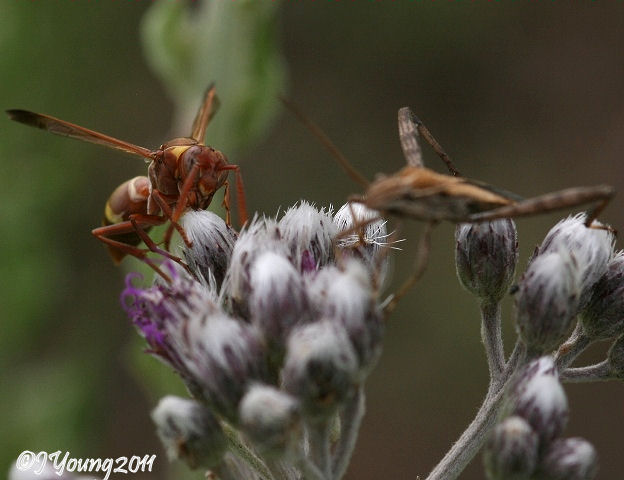
 Here a Paper Wasp and an Assassin Bug both crawl around the wild plant and stay out of each others way. In fact, each one has the capabilities of killing the other but not today.
 The Cotton Stainer and the Ant co-exsist too. (Sorry this picture below is on its side but Blogger is really messed up isn't it?????)
 An Ant and a Small Dotted Chafer. There does not seem to be much food on these plants which to me seem very paperish and yet they must get something out of it else they would not be on it. Maybe it is sweet??
 Wild flowers come in such pretty shapes and the lovelist colors. The whole head of the orange one is maybe 1 inch in diameter.
 This one is very unusual and also very small. The smallness makes me wonder as there are not many large wild flowers. Is there a reason they are mostly tiny??

Monday, June 6, 2011

Autumn Walk - Part 4

If this woodpecker was looking for food in the telephone pole, I hope it does not mean it is rotten and will fall down soon. LOL!!
 This was really a very colorful caterpillar and belongs to one of the tussock moths.
 I dont have a clue as to what spider this is as my knowledge of them is not too good. At a guess I would say it is one of the rain spider. He blended in beautifully with the ground and has a lovely pattern on his back.
 It is a very small spider, maybe 1/2 an inch in length.
 I thought I was going to see some action here but as the spider approached, the grasshopper jumped away so no meal for the spider unfortunately.

Saturday, June 4, 2011

Catopsilia florella - African Migrant

The African Migrant is one of our biggest butterflies and as hard as I have tried, I cannot get a picture of it with the wings open.

 At the end of summer they migrate in huge numbers and feed on Acacia trees.


 Every winters day brings about spectacular sunsets.......


Thursday, June 2, 2011

Silver Terminalia (Terminalia sericae)

Terminalia belong to the Combretum (Combretaceae) family and are widespread in Africa. Of them all, the Silver Terminalia has to be the most beautiful and because of the silver leaves which it gets its name from and is probably the most easily recognizable of them all.

They are usually 4-6m (12-18 feet) in height and prefer sandy soil. The flowers do not have a pleasant smell however but  the red seed pods make this tree very attractive.

Among African peoples this tree has a wide variety of uses. A decoction of the bitter roots is not only taken for diarrhoea and to relieve colic, but is also applied as an eyewash. A hot infusion of the roots’ outer layers makes a fomentation for treating pneumonia. A glucoside, nerifolin, has been isolated from parts of the plant and this has been found to have an effect on the heart and pulse rate.
 The silky, silvery leaf hairs are used by potters for glazing their wares. The hard yellow wood provides a useful general purpose timber for furniture and fence posts.


Good crops are ensured at harvest time and planting time by thrusting a stick into the floor in homage to ancestral spirits but to cut down a whole tree is believed to bring hail storms.

Tuesday, May 31, 2011

Autumn Walk - Part 3

There are days when you just can’t seem to get the picture you want and all you end up with are either butt shots…….

Or the insect hiding away in a place where you cannot get a decent shot. J

Galls are outgrowths on the surface of lifeforms caused by invasion by other lifeforms, such as parasites or bacterial infection. Plant galls are abnormal outgrowth of plant tissues and can be caused by various parasites, from fungi and bacteria, to insects and mites. Plant galls are often highly organized structures and because of this the cause of the gall can often be determined without the actual agent being identified. This applies particularly to some insect and mite plant galls. In pathology, a gall is a raised sore on the skin, usually caused by chafing or rubbing.

Insect galls are the highly distinctive plant structures formed by some herbivorous insects as their own microhabitats. They are plant tissue which is controlled by the insect. Galls act as both the habitat and food source for the maker of the gall. The interior of a gall can contain edible nutritious starch and other tissues. Some galls act as "physiologic sinks", concentrating resources in the gall from the surrounding plant parts. Galls may also provide the insect with physical protection from predators.

Insect galls are usually induced by chemicals injected by the larvae or the adults of the insects into the plants, and possibly mechanical damage. After the galls are formed, the larvae develop inside until fully grown, when they leave. In order to form galls, the insects must seize the time when plant cell division occurs quickly: the growing season, usually spring in temperate climates, but which is extended in the tropics.

Lets face it, Stink bugs, Assassin bugs etc are definitely more attractive than their name. Probably their way of making up for that unpleasant smell they put out.

From the side, it is almost colorful.
Information on Galls supplied by Wikipedia.