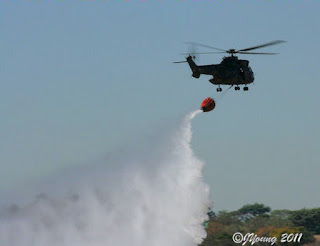
One will not believe that helicopters now days could be so manoeuvrable. The one helicopter actually flew upside down in a circle and the last two were doing a face-off which was almost like a ballet.
Helicopter Development in the Early Twentieth Century
At the end of the nineteenth century, the internal combustion engine became available, making the development of full-sized vertical-flight craft with adequate power a possibility. However, other problems remained, particularly those relating to torque, dissymmetry of lift, and control. Inventors during the next two decades built many small prototype helicopters that attempted to solve these problems, but progress came only in small steps.
Gaetano A. Crocco of Italy patented an early cyclic pitch design in 1906. Crocco recognized that a way to change the pitch cyclically on the blades was needed if a helicopter was to work properly in forward flight.
During 1906, the brothers Louis and Jacques Bréguet began their helicopter experiments and meticulously tested airfoil shapes under the guidance of Professor Charles Richet. In 1907, they built the Bréguet-Richet Gyroplane No. 1, one of the first mechanical devices to actually hover. The gyroplane flew for one minute on August 24, 1907 (some sources say September 29, 1907) in what is generally accepted as the first vertical flight. A 45-horsepower (33.5-kilowatt) engine provided just enough power to achieve vertical flight. However, there was no means of control or stability, and it needed four men to steady it while it hovered about 2 feet (0.6 meters) off the ground. Without a control system, it was not a practical helicopter.
On November 13, 1907, the French bicycle maker Paul Cornu became the first person to rise vertically in powered free flight. His helicopter used two counter-rotating rotors to cancel torque. Some control was achieved by placing auxiliary paddle-like wings below the rotors, and sticks held by men on the ground stabilized the machine. Although Cornu achieved a historic first, rising about one foot (0.6 meter) and hovering for about 20 seconds, the controls were inadequate, and the craft never developed into a practical helicopter.
In June 1909, Igor Sikorsky built his first helicopter, the S-1, in Kiev, Russia. The wooden craft weighed 450 pounds (204 kilograms) and had dual coaxial rotors. But the two blades were inefficient, and the most powerful engine that was available, a 25-horsepower (20 kilowatt) Anzani engine, could not lift its own weight. The next year, he built the S-2, which weighed only 400 pounds (181 kilograms) and had a three-blade rotor system. This model could rise, but the engine was too weak to carry a passenger. The machine also shook and vibrated violently because it needed a stiffer frame. Sikorsky turned to airplane development, returning to helicopters only in the 1930s after he emigrated to the United States.

The first vertical flight machine in the United States seems to have been developed by Emile Berliner and John Newton Williams. Berliner designed what may have been the first production rotary aircraft engine, the 36-horsepower (27-kilowatt) Adams-Farwell engine. In 1908, Williams constructed a coaxial machine for Berliner using two of these engines. It reportedly lifted both Williams and the machine—a weight of 610 pounds (277 kilograms)—but was probably steadied from the ground. Williams later built another craft using a 40-horsepower (30-kilowatt) Curtiss engine. It hovered at around three feet (0.9 meter), again steadied from the ground. Berliner also was the first to propose the auxiliary vertically mounted tail rotor.
Professor Zhukovskii and his students at Moscow University may also have constructed a primitive coaxial helicopter in 1910. Zhukovskii was well known for his theoretical contributions to aerodynamics and published several papers on the subject of rotating wings and helicopters.
In 1912, the Russian Boris Yuriev built a 445-pound (202-kilogram) helicopter that had a modern-looking single rotor and smaller tail rotor and large diameter, high aspect ratio blades. The tail rotor was needed to counteract the torque generated by the main rotor but it added weight and like Sikorsky's helicopters, had an undersized engine. The machine never flew properly. But Yuriev was one of the first to use a tail rotor and also one of several pioneers to propose the concept of cyclic pitch for rotor control.

Around 1912, the Danish aviation pioneer Jacob Christian Ellehammer became interested in vertical flight. He designed a coaxial helicopter with counter-rotating rotors that were stacked vertically. Each rotor consisted of a large aluminum ring about 20 feet (six meters) in diameter with six five-foot (1.5-meter) blades attached to the outside edge of the rotors. A cyclic pitch mechanism was used to change the pitch of the rotating blades and for control. Ellehammer made several short hops in the craft.
Two Austrians, Stephan Petroczy and Professor Theodore von Karman, built and flew a coaxial rotor helicopter during the closing years of World War I. Intended for observation, this machine included a pilot/observer position above the wooden counter-rotating rotors, inflated bags for landing gear, and a quick-opening parachute. Three 120-horsepower (89-kilowatt) rotary engines provided power. The machine achieved numerous short vertical flights restrained by cables and reached a height of more than 150 feet (46 meters).

Around 1919, Henry Berliner built a counter-rotating coaxial rotor machine that made brief uncontrolled hops to a height of about four feet (1.2 meters) while steadied from the ground. In 1922, he mounted two coaxial counter-rotating rotors on the wing tips of a Nieuport biplane fuselage. Sets of movable vanes—flat surfaces mounted under the rotors—provided some control. The craft reportedly could maneuver in all directions and obtained a speed of about 40 miles per hour (64 kilometers per hour). In June 1922, it hovered around 12 feet (3.3 meters) off the ground and was successfully demonstrated to the U.S. Army in 1924. The Berliner aircraft are considered the first rudimentary piloted helicopters developed in the United States.

During the late 1910s and early 1920s, Louis Brennan of England's Royal Aircraft Establishment worked on a helicopter with an exceptionally large two-bladed rotor. To deal with the problem of torque, Brennan used a single rotor and mounted propellers on the blades themselves. The use of servo-flaps or ailerons inboard of the propellers achieved control. He took several low-altitude flights, which ended in October 1925, when the machine crashed.

A Russian immigrant to the United States, George de Bothezat, designed and built a four-rotor machine powered by a 180-horsepower (134-kilowatt) rotary engine under the sponsorship of the U.S. Army. It weighed 3,600 pounds (1,633 kilograms), and the x-shaped structure was more than 60 feet (18.3 meters) wide, with four huge fan-shaped rotors mounted at each corner. The pilot controlled individual collective pitch mechanisms for each rotor. De Bothezat flew the helicopter on its first flight at McCook Field near Dayton, Ohio, in October 1922. This flight lasted about a minute and a half as the craft rose six feet (1.8 meters), drifted with the wind, and landed some 500 feet (152 meters) away. Over the next two years, the helicopter made more than 100 test flights—some rising to 15 feet (4.6 meters) and one with three passengers clinging to the frame to demonstrate the machine's stability. The U.S. Army tested the machine and commented favorably on it. But the Army abandoned it because of its complexity and unreliability and because de Bothezat was difficult to work with.

Information supplied by:


 In the early part of the 1800's when the settlers were heading from the Cape inland and discovering the area around Kruger National Park, this tree was blamed for their bouts of malaria.
 It only grows where there is water on the edge of streams and rivers.
 The flowers...
 The bark is a yellowish-green. This plant has root nodules containing nitrogen fixing bacteria as do most members of the Mimosaceae family and these play an important role in the nitrogen enrichment of soils which then has a positive impact on the growth of plants around the fever tree. The dappled shade underneath the canopy is ideal for smaller plants which require protection from the full brunt of the suns rays but still require sufficient light.
 The bark is covered with very fine yellow powder and they thought that it was this which caused them to be sick. In those days, the name "malaria" was not yet known, but they did get high fevers supposedly from the tree and so called it the Fever Tree (Acacia xanthophloea).


 This extremely tiny bug seemed as if he was rolling around on it. Unfortunately, this is the only shot I could get of him before he flew off.
 Then there are butterflies...


